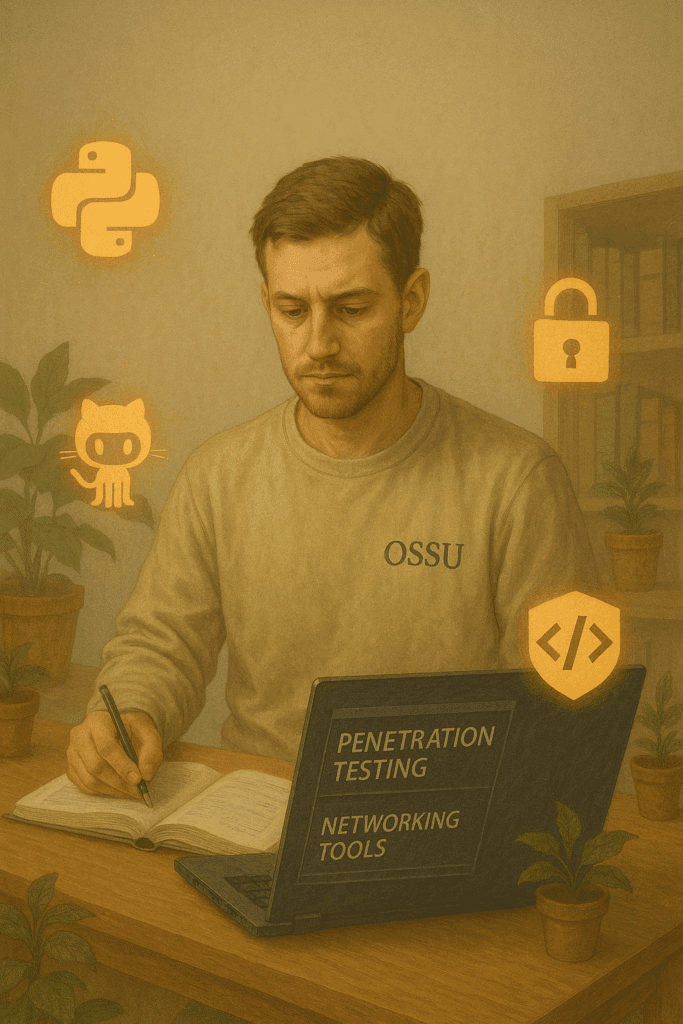
When people hear I’m pursuing a cybersecurity career, the first thing they expect is that I’m neck-deep in penetration testing tools or reverse engineering malware. While that’s definitely on the roadmap, I’ve chosen a different starting point — the Cisco Certified Network Associate (CCNA).
Why CCNA? Because I believe that understanding the battlefield is just as important as knowing how to attack or defend. And the battlefield of cybersecurity is the network.
🧠 A Strong Foundation Beats a Fragile Stack
Many people jump straight into cybersecurity without knowing how networks truly work. They memorize ports, install Wireshark, or spin up a Kali Linux box, but when something breaks, they don’t know why.
The CCNA doesn’t just teach you terms — it teaches the logic of communication. How packets move, how routers and switches direct traffic, how IP addressing schemes work, and why protocols matter. Once I deeply understand that, I can spot abnormal behavior and design better defenses.
🔒 Cybersecurity Isn’t Just Red Team — It’s Architecture
I don’t want to just hack into systems. I want to build systems that are hard to hack.
Whether you’re configuring firewalls, segmenting networks, setting up VPNs, or monitoring traffic — a solid networking background is essential. Even in AppSec, network security basics help you see how your application interacts with the wider system.
💡 Clarity in Learning: One Layer at a Time
Cybersecurity is a massive field. Instead of spreading myself too thin, I’m choosing layered mastery:
- Networking (CCNA)
- Core Programming (OSSU basics)
- System fundamentals (OSTEP, Linux, etc.)
- Then deeper cyber (TryHackMe, PortSwigger, HTB, PNPT)
This way I don’t just follow a checklist of tools — I understand the systems I’m securing.
⚔️ From Defense to Offense — the Right Way
Eventually, I want to get into pentesting, bug bounties, and advanced AppSec. But if I don’t understand things like routing tables, NAT, VLANs, or ACLs, I’ll miss half the picture.
The CCNA gives me the eyes to see what’s really happening beneath the surface.
🛠️ My Tools Now Are Humble — But Grounded
Right now, I’m focusing on:
- Subnetting and IP math
- Cisco Packet Tracer labs
- Learning how routing protocols like OSPF and EIGRP work
- Practicing CLI commands for real switches and routers
It’s not glamorous, but it’s real. And it’s giving me the confidence that I’ll need when things break in production environments or when I’m analyzing a live security breach.
✝️ Doing It With Purpose
More than just career success, I’m doing this to be a good steward of the talents and opportunities God has given me. I want to be excellent at my craft — not just for a paycheck — but to serve others and build resilient systems in a world that’s increasingly vulnerable.
Final Thoughts
Cybersecurity is not about shortcuts. It’s about knowing your stuff. Starting with CCNA means I’m choosing to learn the fundamentals deeply, even if it takes time. Because when I move deeper into cybersecurity — I want to do so with strength, clarity, and purpose.
If you’re just getting started like me, consider this: maybe it’s not about how fast you go — but how strong your roots are.